Contact center AI technology is transforming how businesses support and engage their customers. By leveraging AI call center solutions the next era of business growth - companies can reduce long wait times, handle repetitive questions efficiently, and empower agents to focus on complex issues. The benefits of Contact Center AI are clear: faster response times, personalized experiences, and consistent service across every channel.
Today, cloud computing with AI is helping companies work smarter by storing and managing large amounts of data in secure online systems. Using computer technology and digital tools, businesses can organize information, track customer needs, and improve marketing operations. AI is also helping marketing teams run better online campaigns, understand audiences, and measure results easily. In finance, AI supports faster transactions, smarter financial planning, and clearer insights into spending and investments. By connecting contact centers with these areas, companies can create a smooth system where customer service, marketing, financial planning, and technology all work together. This shows how Contact Center AI technology not only improves service but also helps businesses grow and adapt more quickly.
Whether you run a growing support team or a large enterprise contact center, AI offers a practical way to increase capacity, improve satisfaction, and reduce operating costs at the same time. This guide walks through what contact center AI is, how it works, the real business benefits, and how to get started with confidence.
Top Contact Center AI Technology Providers in 2025
AI is reshaping the way businesses manage customer service, and contact centers are at the forefront of this transformation. Companies are now adopting contact center AI technology to improve customer experiences, reduce wait times, and empower agents with smarter tools. Here’s a list of leading platforms in the industry that offer AI-driven contact center solutions:
1. Bright Pattern
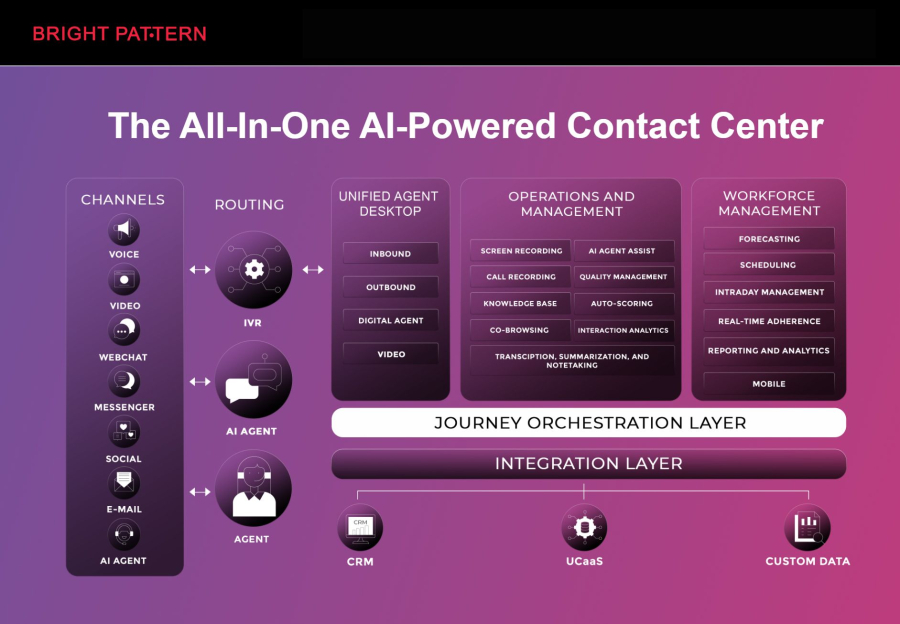
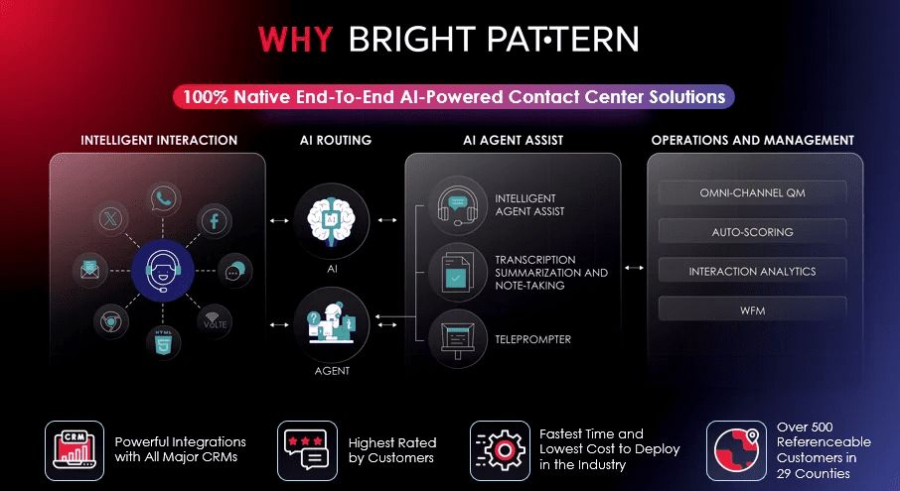
Bright Pattern is a cloud-based contact center platform designed to simplify customer interactions while delivering personalized and efficient service. It combines AI-powered features with a user-friendly interface to help businesses of all sizes scale their support operations.
Key features and benefits:
- AI-assisted agent guidance for faster resolution
- Omnichannel support including voice, chat, email, and messaging apps
- Smart routing based on customer history and preferences
- Analytics dashboard with real-time insights for managers
- Easy integration with CRM systems and other business tools
Bright Pattern’s AI call center solutions help companies improve agent productivity, increase customer satisfaction, and optimize operational costs. By leveraging AI to predict customer needs and automate routine tasks, it empowers agents to focus on high-value interactions.
2. Genesys
Genesys provides AI-driven contact center software that emphasizes personalized customer journeys. Its solutions include predictive routing, AI chatbots, and advanced reporting tools.
3. Five9
Five9 delivers cloud contact center software with AI capabilities for omnichannel engagement, workforce optimization, and automation to enhance customer service efficiency.
4. NICE inContact
NICE inContact offers AI-powered cloud contact center solutions with features like speech analytics, automated workflows, and personalized customer experiences.
5. Talkdesk
Talkdesk provides a flexible cloud-based contact center platform with AI-powered tools for intelligent routing, virtual agents, and workforce management.
6. Avaya
Avaya combines cloud and on-premise solutions with AI features that optimize agent performance, improve customer engagement, and enhance contact center operations.
7. RingCentral
RingCentral Contact Center integrates AI to streamline communication, improve agent efficiency, and deliver predictive analytics across multiple channels.
8. 8x8
8x8 offers AI contact center solutions with real-time analytics, intelligent automation, and multichannel customer support capabilities.
9. HubSpot Service Hub
HubSpot Service Hub provides AI tools for ticketing, automation, and customer feedback management, helping businesses deliver faster and smarter service.
10. Zoho Desk
Zoho Desk uses AI to assist agents, automate repetitive tasks, and provide insights into customer interactions for improved service quality.
What Is Contact Center AI Technology?
Contact center AIrefers to a set of artificial intelligence tools and capabilities designed specifically for customer service and support operations. These tools work alongside your agents, systems, and processes to automate tasks, understand customer intent, and provide intelligent assistance in real time.
Contact center AI commonly includes:
- Virtual agents and chatbotsthat can handle routine inquiries through voice or text.
- AI-powered routingthat sends each interaction to the best available resource based on skills, history, or priority.
- Agent assistthat suggests answers, next best actions, and relevant knowledge while the conversation is happening.
- Speech and text analyticsthat automatically analyze calls and messages to uncover trends, sentiment, and opportunities.
- Workforce intelligencethat helps forecast demand, schedule staff, and optimize performance.
Instead of replacing human agents, modern contact center AI is designed toaugmentthem, taking over repetitive work so people can focus on complex, high-value customer interactions.
How Contact Center AI Works (In Plain Language)
Under the hood, contact center AI combines several core technologies. You do not need to be a data scientist to benefit from them, but understanding the basics helps you see what is possible.
1. Natural Language Processing (NLP)
Natural language processingenables systems to understand and respond to human language as it is actually spoken or typed. It powers:
- Virtual agents that can understand free-form customer questions.
- Intent detection (for example, billing question versus cancellation request).
- Automatic transcription of voice calls into searchable text.
2. Machine Learning Models
Machine learningallows AI systems to improve over time by learning from data. In a contact center, ML models can:
- Predict which customers may need priority handling.
- Suggest the most effective responses to common inquiries.
- Identify patterns in complaints, churn, or product issues.
3. Speech Recognition and Text-to-Speech
For voice channels, AI uses:
- Automatic speech recognitionto convert spoken words into text.
- Text-to-speechto generate natural-sounding spoken responses.
This lets virtual agents converse with customers over the phone, and lets analytics tools process conversations at scale without human transcription.
4. Integration with Your Contact Center Platform
AI becomes truly powerful when it is connected to your existing systems, such as:
- Contact center platforms and ACD / IVR systems.
- Customer relationship management (CRM) tools.
- Knowledge bases and product information.
- Order management or ticketing systems.
Through these integrations, AI can personalize interactions using customer history, pull accurate data in real time, and update records automatically after each contact.
Key Components of Contact Center AI
Most successful AI-enabled contact centers use a combination of complementary capabilities. Below is a breakdown of the most impactful components and how they improve daily operations.
1. AI Virtual Agents and Chatbots
Virtual agents(sometimes called intelligent virtual assistants or chatbots) are AI-powered systems that can interact directly with customers via chat, messaging, or voice. They are ideal for handling:
- Simple FAQs (for example, opening hours, return policy, order status).
- Step-by-step processes (for example, password reset, appointment booking).
- Basic account management tasks.
When they detect a complex issue or a frustrated customer, they can seamlessly transfer the interaction to a human agent, along with context and conversation history. This reduces friction and protects the customer experience.
2. AI-Powered Routing and Prioritization
Instead of routing based solely on simple rules (for example, first available agent), AI can route based on:
- Customer profile and history.
- Agent skills, language, or certifications.
- Sentiment and urgency detected in the initial interaction.
- Business priorities, such as high-value accounts.
This leads to more effective matches between customers and agents, shorter handling times, and higher resolution rates on the first contact.
3. Real-Time Agent Assist
Agent assisttools provide live guidance during customer conversations. Powered by AI, they can:
- Surface relevant knowledge base articles as the customer is speaking.
- Suggest responses or next best actions that comply with your policies.
- Highlight upsell or cross-sell opportunities based on context.
- Flag potential compliance issues in real time.
New agents become productive faster, and experienced agents can handle more complex tasks with greater confidence and consistency.
4. Conversation Analytics and Quality Monitoring
Conversation analyticstools automatically analyze large volumes of calls, chats, and messages. They can help you:
- Discover emerging issues before they become widespread problems.
- Measure customer sentiment and emotional tone.
- Identify training needs and coaching opportunities.
- Track adherence to scripts or regulatory guidelines.
Instead of manually reviewing a small sample of interactions, leaders gain insight across the full customer journey, enabling data-backed decisions.
5. Predictive and Proactive Support
With enough historical data, AI can help your contact center shift from reactive to proactive. Examples include:
- Forecasting spikes in contact volume and adjusting staffing in advance.
- Identifying customers who may be at risk of churn and prioritizing outreach.
- Triggering proactive notifications when common issues are likely to arise.
The result is a smoother customer experience and more efficient use of resources.
Business Benefits of Contact Center AI Technology
When implemented thoughtfully, contact center AI delivers clear and measurable benefits for both customers and the business.
1. Faster Response Times and 24 / 7 Availability
Virtual agents and automated workflows allow you to provide support around the clock without requiring a fully staffed team at all hours. Common benefits include:
- Drastically reduced wait times for simple inquiries.
- Self-service options available whenever customers need them.
- More capacity during peak periods, such as holidays or product launches.
2. Improved Customer Satisfaction and Loyalty
AI enablesmore personalized and consistent experiencesby using customer data and interaction history to shape each conversation. Customers benefit from:
- Quicker resolutions and fewer transfers.
- Agents who already understand context when the call or chat begins.
- Consistent answers across channels, from phone to chat to email.
Over time, these improvements contribute to stronger loyalty and positive word of mouth.
3. Higher Agent Productivity and Engagement
By offloading repetitive tasks and providing real-time support, AI allows agents to focus on more engaging, complex work. Benefits include:
- Reduced handle times per contact, without sacrificing quality.
- Less time spent on manual after-call paperwork.
- Greater confidence when handling unfamiliar or complex topics.
- Lower burnout from constant high-volume, low-value interactions.
Happier, more effective agents translate directly into better customer experiences.
4. Lower Cost per Contact
Automation and smarter routing help you serve more customers without proportionally increasing headcount. Organizations often see:
- More contacts resolved through self-service channels.
- Shorter interaction times when human support is needed.
- Fewer repeat contacts for the same issue.
The result is a reduced average cost per contact and the ability to reinvest savings into higher-value initiatives.
5. Better Operational Visibility and Decision-Making
With AI-driven analytics, leaders gain a detailed picture of what is happening in their contact center at any moment. You can:
- Monitor key performance indicators with more context and depth.
- Spot process bottlenecks and fix them quickly.
- Align training, staffing, and product decisions with real customer needs.
Instead of relying on assumptions, you can make confident, data-backed decisions that move the entire organization forward.
AI in Action: Common Use Cases for Modern Contact Centers
Contact center AI technology is flexible, so it can be tailored to your industry, use case, and customer demographic. Below are some of the most common and impactful applications.
1. Intelligent Self-Service
Use AI virtual agents to allow customers to:
- Check order status or shipment progress.
- Update contact information or payment methods.
- Reset passwords or manage account access.
- Schedule, reschedule, or cancel appointments.
These tasks are perfect for automation: they follow clear rules, are frequently requested, and benefit from instant responses.
2. Assisted Sales and Upselling
AI can support sales-focused contact centers by:
- Recommending products or plans based on customer history and preferences.
- Suggesting bundles or add-ons that match stated needs.
- Highlighting high-value leads in real time so agents can prioritize them.
This leads to higher conversion rates and greater average order value while still delivering a customer-centric experience.
3. Technical Support and Troubleshooting
For technical support, AI can streamline the entire process by:
- Guiding customers through basic troubleshooting steps automatically.
- Gathering key details before routing to a technician.
- Providing agents with likely root causes and recommended solutions.
Customers reach the right expert faster, and technicians spend their time solving issues rather than collecting basic information.
4. Collections and Billing Inquiries
In billing and collections environments, contact center AI can:
- Verify identity and present balance information securely.
- Offer payment plan options and process payments.
- Prioritize outreach based on risk and responsiveness.
Automation helps agents handle sensitive conversations with better preparation and more accurate data.
5. Customer Feedback and Voice of the Customer
Rather than relying solely on periodic surveys, AI can analyze:
- Everyday conversations for sentiment and themes.
- Keywords related to product quality, pricing, or service issues.
- Patterns that indicate satisfaction, frustration, or churn risk.
This gives product, marketing, and operations teams a clearer view of customer needs in near real time.
Traditional vs AI-Enhanced Contact Centers
The table below summarizes how AI changes the core dynamics of a contact center.
Aspect | Traditional Contact Center | AI-Enhanced Contact Center |
Availability | Limited by staffing hours | 24 / 7 self-service with human backup |
Routing | Basic rules, limited personalization | Intent, value, and skill-based routing |
Agent Support | Manual lookups and scripts | Real-time guidance and suggestions |
Analytics | Sample-based, mostly manual | Automated analysis across all interactions |
Customer Experience | Inconsistent, depends on individual agents | More consistent, contextual, and personalized |
Scalability | Requires proportional staffing increases | Scales efficiently with automation |
Designing a Successful Contact Center AI Strategy
To realize the full benefits of contact center AI technology, it is helpful to approach implementation strategically rather than as a one-off tool purchase.
1. Define Clear Objectives
Start by identifying the business outcomes you want to achieve. Common objectives include:
- Reducing average handle time while maintaining quality.
- Increasing first contact resolution.
- Raising customer satisfaction scores.
- Expanding support hours without expanding headcount.
Clear goals help you prioritize AI use cases and measure success.
2. Map Customer Journeys and Pain Points
Walk through your key customer journeys to identify:
- High-volume, repetitive inquiries that are strong candidates for automation.
- Moments of friction, such as long wait times or frequent transfers.
- Critical touchpoints where personalization adds the most value.
Use this understanding to decide where AI can deliver quick wins and where it should carefully augment, rather than replace, human interaction.
3. Start with High-Impact, Low-Risk Use Cases
Many organizations see success by beginning with contained, clearly defined use cases, such as:
- Automating basic account balance or order status inquiries.
- Using AI to summarize calls for faster after-call work.
- Deploying agent assist for one product line or queue.
This approach builds internal confidence, generates early value, and provides real-world data to refine your AI strategy.
4. Involve Agents Early and Often
Your agents are the experts on day-to-day customer interactions. Involving them in design and rollout brings several advantages:
- They help identify tasks that are ideal for automation.
- They validate response quality and suggest improvements.
- They become advocates for the tools rather than feeling threatened by them.
Position AI as an assistant that removes routine work and allows agents to focus on complex, rewarding interactions.
5. Integrate with Core Systems
To deliver personalized, accurate support, your AI solutions should integrate with:
- CRM and customer data sources.
- Ticketing, order, and billing systems.
- Knowledge bases and internal documentation.
- Existing telephony or contact center platforms.
These integrations allow AI to access real-time information and keep records updated automatically.
6. Measure, Learn, and Continuously Improve
Contact center AI is not a set and forget initiative. Establish clear metrics and feedback loops, such as:
- Containment rates for virtual agents (how often they resolve issues without handoff).
- Changes in average handle time and first contact resolution.
- Customer satisfaction scores before and after AI deployment.
- Agent feedback on usability and impact.
Use these insights to refine conversation flows, training data, and integrations over time.
Ensuring Trust, Quality, and Compliance
As AI becomes central to customer interactions, trust and quality are essential. With a thoughtful approach, you can deliver powerful automation while maintaining high standards.
1. Transparent and Customer-Friendly Experiences
Design AI interactions so customers feel informed and in control:
- Clearly indicate when customers are interacting with a virtual agent.
- Offer an easy path to a human agent at any stage.
- Use natural, clear language that reflects your brand voice.
This builds trust and prevents frustration, especially for sensitive or complex issues.
2. Data Privacy and Security
Contact centers handle sensitive customer data, so it is critical to:
- Follow applicable data protection and privacy requirements.
- Limit access to only the data that AI systems truly need.
- Maintain clear policies for data retention and deletion.
Working with your legal, security, and compliance teams early in the process helps ensure your AI strategy is robust and responsible.
3. Human Oversight and Quality Assurance
Even highly accurate AI solutions benefit from human oversight. Consider:
- Reviewing a sample of AI-handled interactions regularly.
- Providing agents and supervisors with tools to correct AI suggestions.
- Updating training data based on new products, policies, and customer needs.
This combination of automation and expert supervision keeps quality consistently high.
Future Trends in Contact Center AI Technology
Contact center AI continues to evolve rapidly, opening new possibilities for smarter, more empathetic customer experiences. Some key trends include:
- More natural conversationsas language models become better at understanding nuance and context.
- Deeper personalizationusing holistic customer profiles and behavior data.
- End-to-end automationof entire workflows, not just single interactions.
- Stronger collaboration toolsthat connect AI, agents, and back-office teams in real time.
Organizations that build solid AI foundations today will be well-positioned to benefit from these innovations as they mature.
Practical Steps to Get Started
If you are ready to explore contact center AI technology, here is a simple, practical roadmap to move from idea to impact.
- Assess your current environment.Document channels, volumes, systems, and your biggest operational challenges.
- Prioritize 2 to 3 use cases.Choose initiatives that are clearly aligned with business goals and relatively straightforward to implement.
- Engage stakeholders.Include operations, IT, security, and front-line agents in planning. Their input will shape a stronger solution.
- Run a pilot.Start with a limited scope, measure carefully, and gather qualitative feedback from customers and agents.
- Refine and expand.Use lessons from the pilot to improve performance, then roll out to additional queues, channels, or regions.
By moving step by step, you can introduce AI in a controlled, measurable way and demonstrate value early in the journey.
Conclusion: Turning Your Contact Center into a Strategic Advantage
Contact center AI technology offers a rare combination of benefits: faster service, happier customers, more engaged agents, and more efficient operations. By pairing intelligent automation with human empathy and expertise, you can transform your contact center from a cost center into a powerful driver of customer loyalty and business growth.
With a clear strategy, thoughtful implementation, and a focus on continuous improvement, AI becomes more than a buzzword in your organization. It becomes the engine behind a modern, responsive, and resilient customer experience that stands out in a competitive market.
